


Acne Marks vs Acne Scars: What Can and Can't Be Fixed

Updated: Sep 29
中文摘要在文末
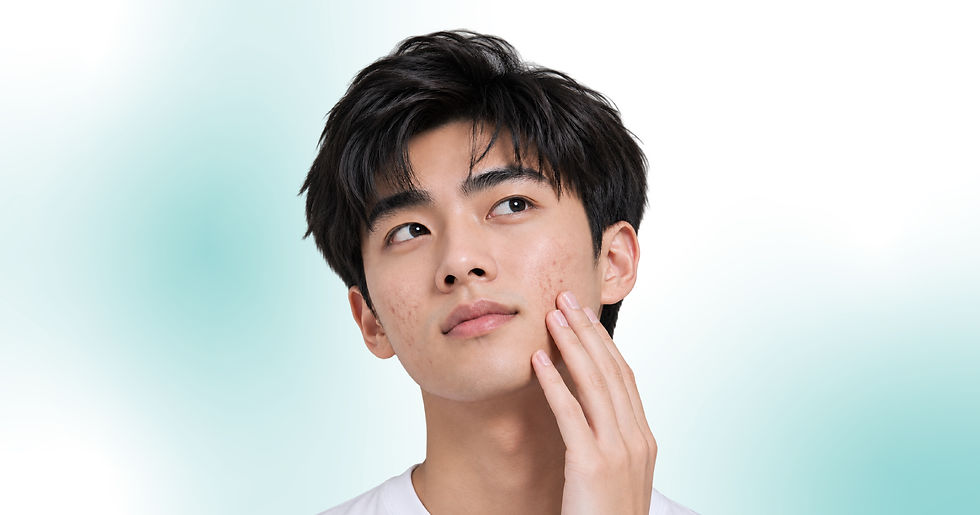
Almost everyone who comes to me about "acne scars" doesn't have scars. They have marks.
That's not me being pedantic. The distinction determines what's realistically achievable, what it costs, and how long it takes — and it's the first thing I explain at a new consultation, before we discuss any treatment.
Marks
Marks are colour changes. The structure of the skin is intact; the colour isn't.
Two kinds:
Post-inflammatory hyperpigmentation (PIH) — the brown or dark marks left where a lesion was. Very common in skin like ours, and the main reason acne here leaves a visible trail long after the spots themselves have gone.
Post-inflammatory erythema (PIE) — the red or pink marks. More common in lighter skin, but they occur across the range.
Run your finger over a mark and the skin feels smooth. It's flat. It's just the wrong colour.
Marks respond well to treatment, and that's the good news I'd want you to leave with. Not overnight — the Fade phase of the programme takes around three months — but they genuinely clear.
Scars
Scars are structural. The architecture of the skin has actually changed.
Three main types:
Ice pick — narrow, deep, steep-sided. Like the skin has been pricked with something fine.
Boxcar — wider, with defined edges and a flat base. Squarish depressions.
Rolling — broad, shallow, with sloping edges, giving the skin an undulating look rather than a pitted one. Often most visible in raking light.
Run your finger over a scar and you can feel it. The surface isn't smooth. That's the simplest home test for which one you have, and it's reliable enough for our purposes.
What I'll tell you at the first visit
I say this early, deliberately, and before anyone spends money:
Marks we can usually clear quite well. Scars I can improve to some degree — but not eliminate.
I'd rather set that expectation on day one than let you discover it at month six after investing in a programme with a picture in your head that was never achievable.
Scars are permanent structural change. Procedures can soften them, reduce their depth, make them catch light less harshly. That's a real and worthwhile improvement, and for many people it's a meaningful difference. But "improved" is the honest word, not "removed," and anyone promising you removal is overselling.
For scar procedures, I refer out. That's not something I do here.
The rule that matters more than anything else on this page
Here it is, and it's the single most expensive mistake I watch people make:
Nothing you do to marks or scars will hold while active acne is still breaking out.
Let me explain the mechanism, because "control the acne first" sounds like a delaying tactic if you don't understand why.
When acne is active, inflammation is continuing in the deeper layers of the skin — slowly, persistently, below what you can see. The visible spot is the surface expression of something happening underneath.
So you can treat the marks. You can have a procedure for the scars. And for a while, it looks better — genuinely better, you're not imagining it.
Then the inflammation from underneath surfaces, and the marks and scars worsen back.
What people conclude from this is that the treatment didn't work. Often the treatment was fine. The sequence was wrong.
I see this constantly: someone spends significant money on scar procedures while their acne is still active, gets a temporary improvement, watches it regress over months, and arrives at my clinic having concluded that nothing works on their skin.
The order is: control the active acne, then address what it left behind. That's why the programme runs Clear first, then Fade. It isn't me stringing you along — it's the only order in which the work holds.
So what does the sequence actually look like?
Clear phase, around three months. All focus on stopping new breakouts. We're not fading anything yet. The actives are being titrated up while we watch how your skin tolerates them.
I know this is frustrating if marks are what's actually bothering you. Many patients tell me the marks distress them more than the spots do — and that's completely legitimate; a mark sits on your face for months whereas a spot lasts days. But the three months isn't lost time. It's the foundation the fading is built on.
Fade phase, around another three months. Now we add pigment actives specifically to address PIH.
Then, if there's structural scarring to address, that's the point at which a referral for procedures makes sense — with the underlying process controlled, so the improvement holds.
Preventing marks and scars in the first place
Prevention beats both, by a wide margin.
Scarring happens mainly through two routes. Large nodulocystic lesions — the deep, painful ones — and popping.One of those is entirely within your control, and there's a separate article on why extraction and popping cause more damage than people realise.
Marks are largely about how much inflammation occurs and for how long. Which means the fastest way to reduce future marks is to control the acne properly and early, rather than letting each lesion run its full inflammatory course.
And sunscreen. PIH darkens and persists with sun exposure. Every mark you're currently trying to fade will fade slower, and darker, if you're not using sunscreen — which is why sunscreen is non-negotiable throughout the programme regardless of how humid it is or how much you sweat. If it's uncomfortable by midday, clean the face with plain water, pat dry, and reapply. Plain water, not another round of cleanser on skin that's already being worked by actives.
If marks are your main concern
Some people come to me specifically about marks, with acne that's fairly quiet.
That's a different conversation, and a shorter one — if the active process is genuinely under control, we can go more directly to fading. The assessment is whether it's actually quiet or just quieter, which is worth an examination rather than a judgement from the mirror.
Bring photographs if you have them, particularly from when the acne was more active. It helps me see whether what's left is stable or still being added to.
And if you've been told they're scars
Get a second look before committing to expensive procedures.
I'm not suggesting anyone would mislead you. But marks and scars get conflated constantly, including in how treatments are marketed, and the two need completely different approaches. A mark treated as a scar is money spent on the wrong problem — and a scar treated as a mark is disappointment waiting six months out.
Klinik Dr Tan (Skin & Acne), Lot 27, Ground Floor, Block D, Lintas Square, Kota Kinabalu. WhatsApp 017-234 7328. Appointments preferred.
Book a consultation with Dr. Tan — Book Online or WhatsApp 017-234 7328.
I'm a GP with a strong interest in skin, not a dermatologist. For scar procedures, I refer.
Read more about our acne treatment programme : Acne Treatment in KK, Diet and Acne, Skin & Acne Protocol
简要说明
我是陈医生,亚庇 Lintas Square 的 Klinik Dr Tan(皮肤与暗疮)。我是对皮肤有专长的普通科医生,不是皮肤专科医生。
几乎每一位来找我谈「痘疤」的人,其实没有疤,他们有的是「痘印」。
这不是咬文嚼字。这个区分决定了实际能达到什么、要花多少钱、需要多久,也是我在初诊会先解释的第一件事。
痘印(marks)=颜色的改变,皮肤结构完整,只是颜色不对。
炎症后色素沉着(PIH)——留在原处的褐色或深色印。在我们这样的肤色非常常见,也是痘痘在这里会留下长久痕迹的主因。
炎症后红斑(PIE)——红色或粉红色的印。
用手指摸过去,皮肤是平滑的。它是平的,只是颜色不对。痘印对治疗反应良好——不是一夜之间(淡化期约三个月),但确实会消退。
痘疤(scars)=结构性的改变,皮肤的构造真的变了。
冰锥型(ice pick)——窄、深、边缘陡。
箱车型(boxcar)——较宽,边缘清楚,底部平坦,方形凹陷。
滚动型(rolling)——宽、浅、边缘倾斜,让皮肤呈现起伏感而非凹洞感。
用手指摸过去,你摸得出来。表面不平滑。这是最简单的居家判断方式。
我在初诊会说的话(刻意早说,而且是在任何人花钱之前):
痘印通常可以处理得不错。痘疤我可以改善一些,但无法消除。
我宁可在第一天就设定这个期望,也不愿意让你在第六个月才发现,你脑中的那个画面从一开始就达不到。疗程可以让疤变浅、变柔和——那是真实且值得的改善。但诚实的用词是「改善」,不是「消除」。 疤痕的疗程我会转介出去。
这一页最重要的规则
只要痘痘还在活跃地长,你对痘印和痘疤做的任何处理都留不住。
机制是这样的:痘痘活跃时,发炎正在皮肤更深的层次持续进行——缓慢、不间断、在你看得见的范围之下。你看到的那颗痘,只是底下某件事的表面表现。
所以你可以处理痘印、可以为疤做疗程,而且有一阵子确实会变好——那不是错觉。
然后底下的发炎浮上来,痘印和痘疤又变回去。
大家从中得到的结论是「治疗没效」。但治疗往往没问题,错的是顺序。
我经常看到:有人在痘痘还活跃时花了不少钱做疤痕疗程,得到暂时的改善,几个月内看着它退回去,然后带着「我的皮肤什么都没用」的结论来到我的诊所。
顺序是:先控制活跃的痘痘,再处理它留下的东西。 这就是疗程为什么先「清除」再「淡化」。这不是我在拖延你——这是唯一能让成果留住的顺序。
实际的顺序:清除期(约三个月)——全部注意力放在阻止新的痘痘。我知道如果困扰你的正是痘印,这会让人不耐烦。很多病人告诉我痘印比痘痘更让他们难受——这完全合理,一颗痘几天就走,一个印会在脸上待好几个月。但那三个月不是浪费掉的时间,它是淡化所建立的地基。 → 淡化期(约再三个月) → 若有结构性的疤要处理,这时候转介做疗程才有意义,因为底下的过程已经受控,改善才留得住。
预防胜过两者:
疤痕主要透过两条路径产生:大颗的结节囊肿型病灶,以及挤压。其中一条完全在你的控制之内(另有专文说明为什么挤压和粉刺清除的伤害比大家以为的大)。
痘印主要取决于发炎有多严重、持续多久。所以减少未来痘印最快的方法,是及早、正确地控制痘痘。
防晒:PIH 会因日晒而变深、变持久。 你现在努力想淡掉的每一个印,如果没擦防晒都会淡得更慢、更深。中午不舒服的话:用清水洗、拍干、补擦(清水就好,不要再洗一次面)。
如果痘印是你的主要困扰:有些人来的时候痘痘已经相当安静,那是不同的、也比较短的对话——如果活跃的过程真的受控了,我们可以更直接进入淡化。 关键在于判断它是真的安静了,还是只是比较安静,那需要检查,而不是对着镜子判断。有以前痘痘比较活跃时的照片请带来。
如果有人告诉你那些是疤:在投入昂贵疗程之前,再看一次。痘印和痘疤经常被混为一谈(包括在疗程的行销方式里),而两者需要完全不同的做法。把痘印当疤治,是把钱花在错的问题上;把疤当痘印治,是六个月后等着你的失望。
Klinik Dr Tan (Skin & Acne),Lot 27, Ground Floor, Block D, Lintas Square, Kota Kinabalu。WhatsApp:017-234 7328。建议预约。疤痕疗程我会转介。


Comments