


Children's Eczema: A Guide for Parents

Updated: Sep 29
中文摘要在文末
I'm going to say something that sounds rude, and then I'm going to explain it.
When a child comes into my clinic with eczema, I'm not really treating the child. I'm treating the parents.
Not because you've done anything wrong. Please hear that properly. Nine times out of ten the parent sitting in front of me is doing everything they think they're supposed to, and doing it with an intensity I find genuinely moving. Mothers who haven't slept properly in four months. Fathers who've read every article on the internet at two in the morning. Nobody in that room is being lazy.
The problem is that the child isn't the one who applies the cream. You are. The child isn't the one who decides how long the bath is, what soap gets used, whether the aircon is on, whether the cream goes on twice a day for three weeks or gets forgotten by day four because the skin looked fine. Every single lever that controls this disease is in your hands, not theirs.
So the knowledge gap is the parent's gap. And the discipline of application is the parent's discipline. That's what I mean when I say I treat the parents.
First, the thing you're most scared about
You're worried about steroids. Every parent is. Someone in the family WhatsApp group has told you that steroid creams will stunt your child's growth, thin their skin permanently, or "go into the blood."
Here's my honest position.
I treat children differently from adults, and deliberately so. With adults I go in aggressively — hit hard, get control, taper down. With children I go slow and steady. Lower potency. Shorter courses. Careful about which body part. A child's skin is thinner, their surface-area-to-weight ratio is different, and I have no interest in being clever with someone's four-year-old.
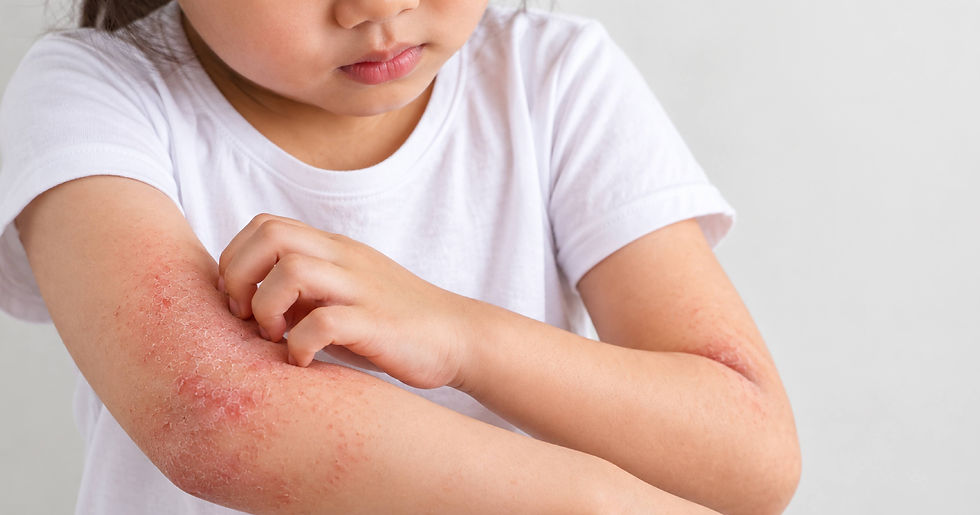
But slow and steady is not the same as doing nothing, and this is where a lot of families get stuck. Untreated eczema is not a neutral outcome. A child who itches all night doesn't sleep. A child who doesn't sleep doesn't concentrate at school, gets irritable, gets sick more often. A child who scratches until they bleed gets skin infections, and I see those constantly. The skin also becomes thickened and leathery over time from years of scratching — that's a real, visible, long-term change, and it's caused by the untreated eczema, not by the medicine.
So the choice isn't "steroid risk versus no risk." It's "supervised short courses of an appropriate-strength steroid" versus "years of chronic inflammation and broken sleep." When you frame it that way, it's not a close call.
And if you're still uncomfortable — say so. I mean it. There are calcineurin inhibitors, tacrolimus and pimecrolimus, which contain no steroid at all. I reach for these often in children, especially on the face, around the eyes, and in the skin folds where I'd rather not use steroids repeatedly. They sting a little for the first few applications and then stop. They're a proper alternative, and I'd rather use them and have you actually apply the cream than prescribe something you're going to leave in the drawer.
The part that actually decides whether this works
Moisturiser. I know. Not exciting.
But if I could get every parent in Sabah to do one thing, it would be this: moisturise properly, every single day, forever, including on the good days.
Most parents apply moisturiser the way you'd apply it to normal skin — a thin smear, once a day, when they remember. That's not treatment, that's a gesture. What a child with eczema needs is a proper ceramide-based emollient applied generously, at minimum twice a day, and reapplied after every bath while the skin is still slightly damp. If it feels like you're using a lot, you're probably using the right amount. A child with moderate eczema can genuinely go through a large tub in a few weeks.
The steroid or the tacrolimus is the fire extinguisher. The moisturiser is the thing that stops the fire starting. Families who understand this get years of quiet skin. Families who only apply cream during flares stay on the flare-treat-stop-flare merry-go-round indefinitely, and then conclude the treatment doesn't work.
Nights, and the scratching
The scratching at night is the part that breaks parents. You've probably lain there listening to it.
A few things help. Antihistamines at night, if I've prescribed them, are less about the itch and more about letting the child sleep through it — a child who is asleep isn't scratching. Cotton mittens for the little ones. Nails cut short and filed, genuinely short, checked weekly. Cotton pyjamas rather than anything synthetic. And the room not too warm — which in Kota Kinabalu usually means the aircon on, though I'd add a fan or a slightly higher temperature so the air isn't bone-dry either.
If the skin is badly inflamed and the nights are terrible, ask me about wet wrap therapy. It sounds fussy — damp layer over the cream, dry layer over that — and the first night is a production. But for a child in a bad flare it can transform sleep within about two nights, and it's the technique I most wish more parents knew about.
Sabah-specific things I see in kids
Sweat is the number one trigger here, and children sweat constantly. Running around at school in this humidity, then sitting in the sweat for hours. What helps is straightforward: a change of shirt in the bag, rinse and re-moisturise when they get home rather than letting dried sweat sit on the skin all evening.
Sea water and pool water cut both ways. Some kids are fine, some flare hard. Don't ban the beach — that's a big thing to take from a child in Sabah — just rinse them off properly afterwards and re-apply the emollient, and watch what happens the first couple of times.
And dust. I once had an adult patient with stubborn eczema only on her ankles, nowhere else, and it made no sense until we worked out her office was under renovation and dust was sitting at floor level all day. Children live closer to the floor than we do. If your child's eczema has a strange distribution that doesn't fit, tell me about your house, your renovations, your new cat, your new sofa. That conversation solves more cases than any prescription I write.
About food
I'm going to be blunt, kindly.
A lot of parents arrive convinced that a food is causing this, and they've already cut out eggs, milk, chicken, seafood, and half the things a growing child should be eating. Months of restriction, and the skin is still bad.
True food-triggered eczema exists, particularly in infants, and I take it seriously when the history genuinely points that way — a consistent, reproducible flare within hours of a specific food, every time. What I don't support is broad elimination based on a suspicion, because the nutritional cost to a growing child is real and the benefit is usually zero.
Treat the skin first. Get it under control with proper topical care. Then, if you still suspect a food, we look at it properly with a clear head. Sorting out the skin makes the food question much easier to answer, because you're no longer trying to read signals through constant background inflammation.
What I'd like you to bring
Come in with everything you've already tried — the pharmacy creams, the traditional remedies, the thing your neighbour recommended, the tub from Shopee. I won't be annoyed. It tells me what the skin has been exposed to, and occasionally it explains the whole picture, because some of those unlabelled products contain strong steroids at unknown potency.
Also come prepared to talk. My consultations for skin are mostly conversation — probably ninety percent talking and ten percent writing a prescription. With children it's even more so, because I need to understand your household, your routine, your school run, and what's realistically going to get done on a Tuesday evening when everyone is tired. A perfect plan you can't follow is worse than a decent plan you can.
We'll message you at around a week to check how it's going. Please reply honestly, including if you haven't managed to do it properly. That's useful information, not a confession.
I'm at Klinik Dr Tan (Skin & Acne), Lot 27, Ground Floor, Block D, Lintas Square, Kota Kinabalu. WhatsApp 017-234 7328 — appointments are better than walk-ins for skin, because these need time.
Book a consultation with Dr. Tan — Book Online or WhatsApp 017-234 7328.
One last thing. Most children with eczema improve substantially as they get older. Not all, but most. The work you put in now isn't just managing today's flare — it's protecting their sleep, their skin, and frankly their relationship with their own body, through the years where it matters. That's worth the tub of moisturiser.
简要说明
我是陈医生,亚庇 Lintas Square 的 Klinik Dr Tan(皮肤与暗疮)。我是对皮肤有专长的普通科医生,不是皮肤专科医生。
给家长的重点:
治疗小孩的湿疹,其实是在教家长。药膏是你涂的,洗澡时间、衣物、冷气、坚持与否,全都在家长手上。
小孩的用药方式和大人不同:我会用较低强度、疗程较短、循序渐进,不像成人那样一开始就用强效药。
类固醇药膏在医生指导下短期使用是安全的。真正的风险是长期不治疗——睡不好、抓到流血、感染、皮肤变厚变粗。
若你不放心类固醇,可以用钙调磷酸酶抑制剂(tacrolimus、pimecrolimus),不含类固醇,特别适合脸部和皮肤皱褶处。
保湿是关键。要用足量、含神经酰胺的保湿霜,一天至少两次,洗澡后趁皮肤微湿时立刻涂,好的时候也要继续涂。
晚上抓痒:剪短指甲、棉质手套、棉质睡衣、必要时晚上服抗组胺药帮助入睡。严重时可询问湿敷疗法。
沙巴常见诱因:流汗(书包里备一件替换衣服)、海水泳池水(玩后冲洗并补涂保湿)、灰尘。
食物:先把皮肤治好,再谈食物。不建议在没有明确证据下大量戒口,对成长中的孩子营养损失是实实在在的。
请把之前用过的所有药膏带来,包括药房买的和网购的,我不会怪你,这些资讯对诊断很有帮助。
诊所:Lot 27, Ground Floor, Block D, Lintas Square, Kota Kinabalu。WhatsApp:017-234 7328,建议预约。


Comments