


Is It Psoriasis, Eczema, or Fungal?

Updated: Sep 29
中文摘要在文末
Psoriasis is the hardest of the three to be confident about, and I'd rather say so than pretend otherwise.
Part of that is variety — psoriasis has several distinct presentations, and they don't all look like each other. But even the most common form, plaque psoriasis, isn't always straightforward to distinguish from what else it could be.
So here's how I actually work through it.
Clue one: is it on both sides?
This is the first thing I look at, and it's more useful than most people expect.
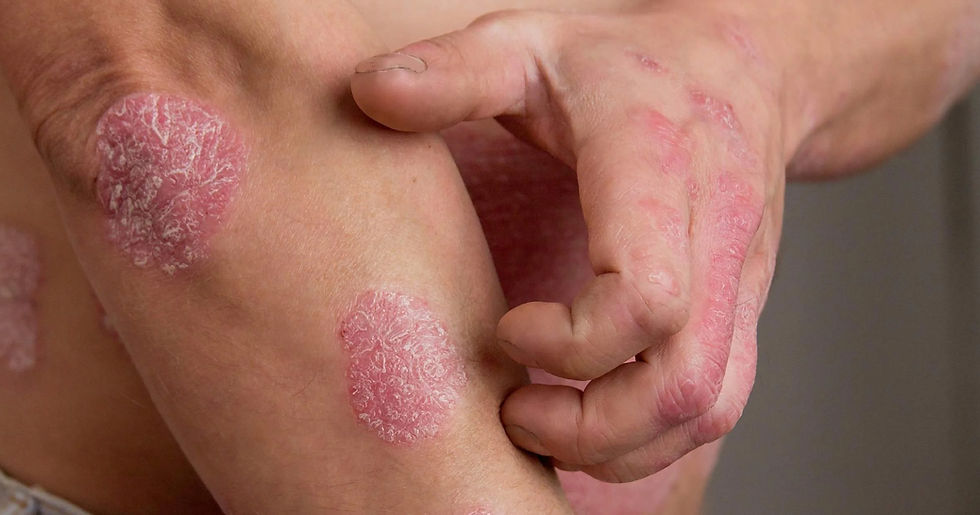
Psoriasis is usually bilateral. Both elbows. Both knees. Both sides of the scalp. It tends towards symmetry.
Fungal infection is often one-sided, at least to begin with — it starts somewhere and spreads outwards from there.
So the question I ask isn't only what it looks like now. It's which side did it start on, and did it appear on both sides at once? If something began firmly on one side only, that pushes me towards fungal.
Clue two: where is it?
Psoriasis favours the extensor surfaces — the outside of elbows, the front of knees. The parts you'd land on.
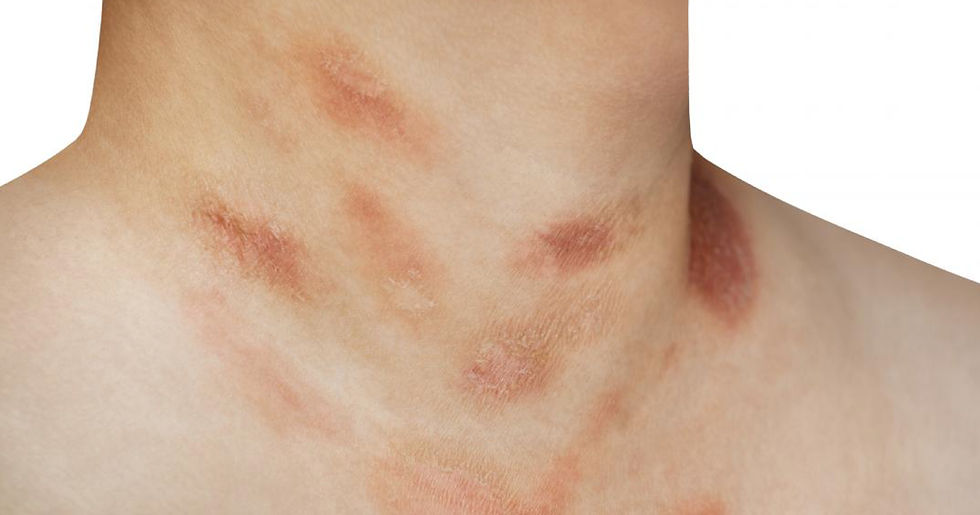
Eczema classically prefers the opposite: flexural areas, the inside of elbows and behind the knees.
Neither is absolute. But when the distribution is textbook, it's genuinely informative.
Clue three: what does the plaque look like?
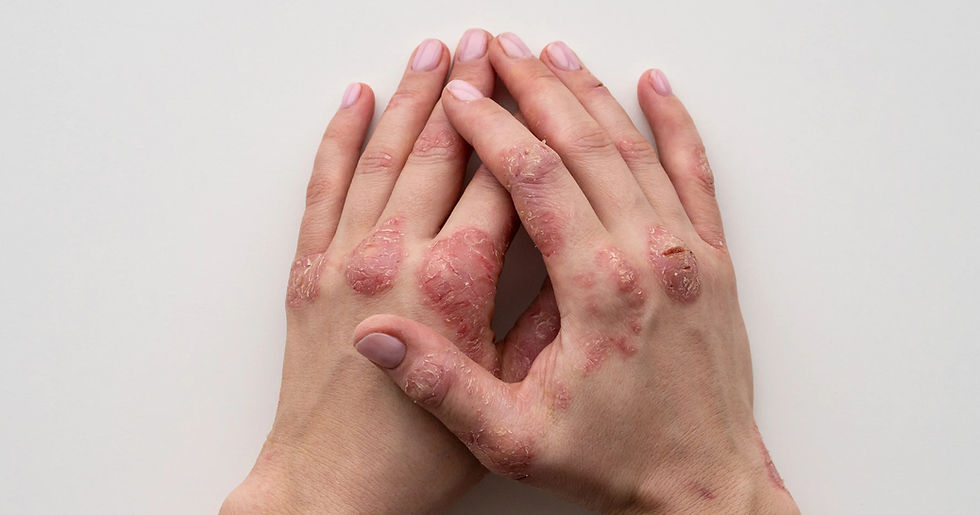
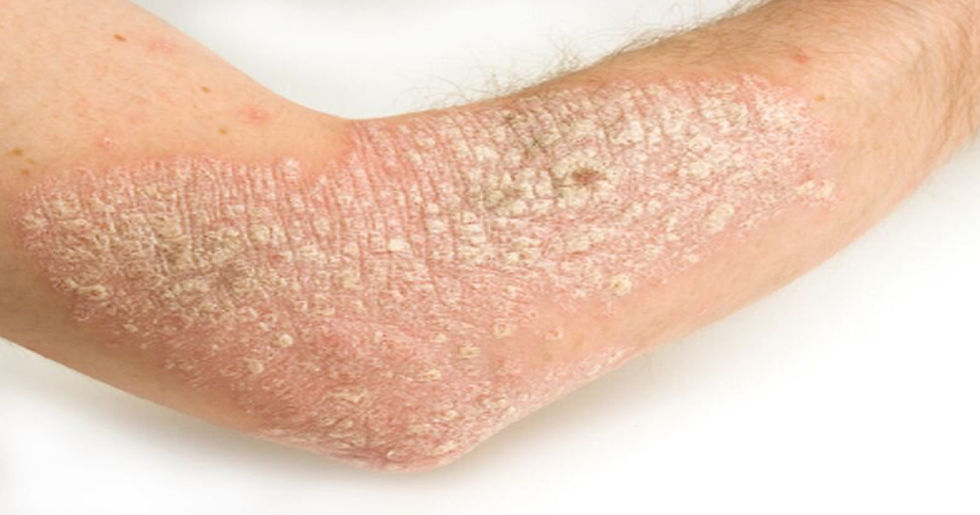
Classical plaque psoriasis is thickened, with silvery scale on top. That scale is fairly distinctive once you've seen a lot of it — it's not the fine flaking of eczema.
And there's a sign worth knowing about: if you pick the scale off, you get pinpoint bleeding from the surface underneath.
I mention this because it's a real diagnostic feature, not because I want you doing it at home. Please don't pick at your plaques to test this — psoriasis responds badly to skin trauma, and deliberately damaging a plaque can make it worse or spread it. I'll assess that in the clinic if it's relevant.
Clue four: the family history
A family history of atopy — eczema, asthma, allergic rhinitis — steers me towards eczema.
So I ask about it, and I ask about the wider family rather than just parents. This is one of the more useful questions in a difficult case and it costs nothing.
Clue five: how fast did it respond to a steroid?
This is the one I find most useful, and it's the one nobody thinks to tell me unprompted.
Most inflammatory skin conditions respond to steroids to some degree. But the speed and completeness of the response differ, and that difference is diagnostic.
Eczema responds fast. Near-immediate improvement — you'd notice within two to three days at most. If someone tells me they used a steroid and things were clearly better by day three, that's an eczema-shaped response.
Psoriasis responds late, and less impressively. Typically what you see is progression stopping at around a week — it's no longer getting worse, but it doesn't look dramatically better either. Then over another couple of weeks it slowly reduces.
That's a completely different curve, and if you tell me which one you experienced, you've given me real information.
Fungal has its own signature, which I've written about separately: better at first, then worse — because the steroid suppresses the immune response that was containing the infection.
So the three patterns are: fast and clearly better (eczema), slow and gradual (psoriasis), and better then worse(fungal).
Which is why I ask what happened with everything you've already tried, and why "I used a cream and it sort of helped a bit" is worth unpacking rather than moving past.
Clue six: the response that's slower than it should be
A refinement of the above, and one that took me a case to properly learn.
Sometimes something responds to treatment — but more slowly than it ought to. It improves, just not the way you'd expect for the diagnosis you've made. And then when you taper, it flares back easily.
That combination is itself a signal. It's the disease telling you that you've got the category slightly wrong.
I used to treat that as a compliance issue or a not-quite-strong-enough issue. Now I treat it as a prompt to reconsider the diagnosis.
When I biopsy
I have a lower threshold for biopsy in suspected psoriasis than in most other skin conditions, and there's a specific reason for it.
It isn't that I'm more uncertain. It's that the treatment differs so much. If it's psoriasis, and it's severe, we may be talking about systemic medication — a different class of decision with different monitoring and different implications. That's not something to commit someone to on a clinical hunch.
So when the picture isn't clear and the answer would change management significantly, biopsy is worth doing rather than treating and hoping.
I'll tell you when I'm recommending one and why.
Groin: usually fungal, but
Almost all the groin involvement I see is fungal, not psoriasis. In this climate that's overwhelmingly the likelier answer, and I'd treat it accordingly.
But inverse psoriasis exists, it appears in exactly those skin folds, and it can meet every criterion you'd use for fungal infection.
I've had that case. The presentation ticked all the fungal boxes. The only thing that didn't fit was that it didn't respond properly to antifungal treatment. That raised the suspicion, we biopsied, and it came back as psoriasis.
So the practical rule I'd offer: groin involvement should be treated as fungal first, because it usually is. But failure to respond to antifungal treatment is the trigger to biopsy — not the trigger to escalate the antifungal.
Adding stronger antifungals to something that isn't fungal wastes months.
The case that taught me the most
An elderly man came to me with chronic dermatitis on both hands and both feet.
He worked in a rough environment daily. Thickened skin over the palms and soles, some fissures, itchy and scaly. That picture fits an irritant hand dermatitis so naturally that it had been treated as dermatitis for months already.
I continued along the same line, and I went in properly — stronger dermatitis treatment, wet wrap therapy, the full approach. And it improved.
But it improved more slowly than I'd expect. And when I tapered, it flared back easily.
So I covered for fungal, even though KOH microscopy was negative. No effect.
At that point I stopped adjusting the treatment and started reconsidering the diagnosis. I suspected palmoplantar psoriasis, took a skin biopsy, and it confirmed it. We started systemic medication and I referred him to hospital dermatology.
Two lessons, both of which changed my practice.
A response that's slower than it should be is itself a sign — not a reason to increase the dose. Improvement is not the same as the right improvement.
And one thing every doctor should learn: always question the diagnosis. If it looks like a duck and quacks like a duck, in skin it is not necessarily a duck. Keep a lower threshold for skin biopsy where there's serious doubt — particularly where the answer would change management significantly.
What you can do to help
Tell me what the first lesion looked like and where it was. Which side. Whether both sides appeared together.
Tell me exactly what each treatment did — not just whether it helped, but how fast, and what happened when you stopped. Fast improvement, slow improvement, and better-then-worse mean three different things.
Mention family history, including relatives with eczema, asthma or hay fever.
Bring photographs if you have them, particularly of the early stages.
Bring everything you've used. All of it.
And mention joint symptoms — stiffness, especially in the morning, or pain in fingers, toes or back. Patients almost never volunteer this because it seems unrelated to a skin appointment. It isn't, and there's a separate article explaining why it matters more than almost anything else here.
Klinik Dr Tan (Skin & Acne), Lot 27, Ground Floor, Block D, Lintas Square, Kota Kinabalu.
WhatsApp 017-234 7328. Appointments preferred, because this is a history-heavy conversation.
I'm a GP with a strong interest in skin, not a dermatologist. Where something needs specialist assessment, I'll say so and refer.
Book a consultation with Dr. Tan — Book Online or WhatsApp 017-234 7328.
Read more about Psoriasis : Psoriasis Treatment, Psoriasis Is Not Just a Skin Disease, Scalp and Nail Psoriasis, The Moving Baseline, 5 Psoriasis Mistakes
简要说明
我是陈医生,亚庇 Lintas Square 的 Klinik Dr Tan(皮肤与暗疮)。我是对皮肤有专长的普通科医生,不是皮肤专科医生。
三者之中,干癣是最难有把握的,我宁可直说。一部分是因为它有多种不同的表现型,而且即使是最常见的斑块型干癣,也不总是容易和其他病区分。
线索一:是不是两边都有? 干癣通常是双侧对称的——两边手肘、两边膝盖。真菌感染常常是单侧的(至少一开始是),从某处开始向外扩散。所以我问的不只是「现在长什么样」,而是**「从哪一边开始?是不是两边同时出现?」** 若明确从单侧开始,我会偏向真菌。
线索二:长在哪里? 干癣偏好伸侧——手肘外侧、膝盖前方。湿疹则相反,偏好屈侧——手肘内侧、膝窝。都不是绝对,但分布典型时确实有参考价值。
线索三:斑块长什么样? 典型的斑块型干癣是增厚、上面有银白色鳞屑。把鳞屑剥掉会有点状出血。
我提这一点是因为它是真实的诊断特征,不是要你在家自己试。请不要抠你的斑块来验证——干癣对皮肤创伤反应很差,刻意破坏斑块可能让它更糟或扩散。需要的话我会在诊间评估。
线索四:家族史。 家族中有异位性体质(湿疹、气喘、过敏性鼻炎)会让我偏向湿疹。 我会问到较广的亲属,不只父母。
线索五:擦类固醇后多快有反应?(我觉得最有用的一条)
多数发炎性皮肤病都会对类固醇有某程度的反应,但反应的速度和完整度不同,而那个差异本身有诊断价值:
湿疹反应快——几乎立即改善,最多两三天就看得出来。
干癣反应慢,而且不明显——通常是约一周时停止恶化(不再变糟,但也没有明显变好),再过两周左右才慢慢消退。
真菌有自己的特征——先好转、后变糟,因为类固醇抑制了正在压制感染的免疫反应。
所以三种模式是:快而明显好转(湿疹)、慢而渐进(干癣)、先好后坏(真菌)。这就是为什么我会问你用过的每一样东西发生了什么事。
线索六:比预期慢的反应。 有时候东西确实有反应,但比它该有的慢;而且一减量就容易复发。这个组合本身就是讯号——疾病在告诉你,你把类别抓得有点偏。 我以前会当成顺从性问题或药力不够,现在我把它当成重新考虑诊断的提示。
什么时候做切片:我对疑似干癣做切片的门槛,比多数皮肤病都低。 原因很具体——不是我比较没把握,而是治疗差别太大。 如果是干癣而且严重,可能要谈到全身性药物,那是不同层级的决定,有不同的监测和影响,不该只凭临床直觉就让病人承担。
腹股沟:通常是真菌,但——
我看到的腹股沟病灶几乎都是真菌,不是干癣,在这个气候下这压倒性地更可能。但反向型干癣(inverse psoriasis)确实存在,就长在皮肤皱褶处,而且可以符合你用来判断真菌的每一项标准。
我有过这样的病例:表现完全符合真菌,唯一不合的是它对抗真菌治疗反应不好。这引起怀疑,切片后确认是干癣。
实用原则:腹股沟先当真菌治疗,因为它通常就是。但对抗真菌治疗没有反应,是「做切片」的时机,而不是「加强抗真菌」的时机。 在不是真菌的东西上加更强的抗真菌药,会浪费好几个月。
教我最多的一个病例
一位年长男性,双手双脚慢性皮肤炎。每天在粗重环境工作,手掌脚底皮肤增厚、有些裂口、又痒又脱屑。这个画面太符合刺激性手部皮肤炎,所以之前已经当皮肤炎治疗了好几个月。
我沿着同样的方向、而且认真地做——更强的皮肤炎用药、湿敷疗法,完整的做法。它确实改善了。
但改善得比我预期的慢。而且一减量就容易复发。
于是我也涵盖了真菌,即使 KOH 显微镜是阴性的。没有效果。
到这个时候,我停止调整治疗,开始重新考虑诊断。我怀疑是掌跖型干癣,做了皮肤切片,确认了。开始全身性药物,并转介医院皮肤科。
两个教训,都改变了我的做法:
比该有的慢的反应,本身就是讯号——不是加重剂量的理由。「有改善」不等于「对的改善」。
每位医生都该学会的一件事:永远质疑自己的诊断。 看起来像鸭子、叫起来像鸭子——在皮肤科,那不一定是鸭子。 在有明显疑虑时,保持较低的皮肤切片门槛,尤其是当答案会大幅改变治疗方向的时候。
你可以帮忙的事:告诉我第一个皮损长什么样、在哪里、哪一边、是不是两边同时出现;详细说明每种治疗做了什么(不只有没有效,还有多快、停药后怎样);提到家族史;带照片(尤其早期的);带上用过的所有东西;以及提起关节症状——晨间僵硬,或手指、脚趾、背部疼痛。病人几乎从不主动说,因为觉得跟皮肤门诊无关。它有关,另有专文说明为什么这可能是这里最重要的一件事。
Klinik Dr Tan (Skin & Acne),Lot 27, Ground Floor, Block D, Lintas Square, Kota Kinabalu。WhatsApp:017-234 7328。建议预约。
Book a consultation with Dr. Tan — Book Online or WhatsApp 017-234 7328.
Comments