


The Moving Baseline: Why Your Psoriasis Changes Over the Years

Updated: Sep 29
中文摘要在文末
This is the article I most wish someone had given my long-term psoriasis patients twenty years ago, because it addresses the thing that quietly demoralises people more than any symptom does.
Psoriasis is not a two-state condition
Most people arrive with a mental model borrowed from eczema, which is reasonable — eczema is the skin condition everyone has heard of.
Eczema is fairly binary. There's a flare: itchy, spreading, angry. And there's maintenance: calm, no scale. You move between two states, and "controlled" means being in the second one.
Psoriasis does not work like that, and almost nobody explains this.
Psoriasis has degrees of flare and degrees of maintenance.
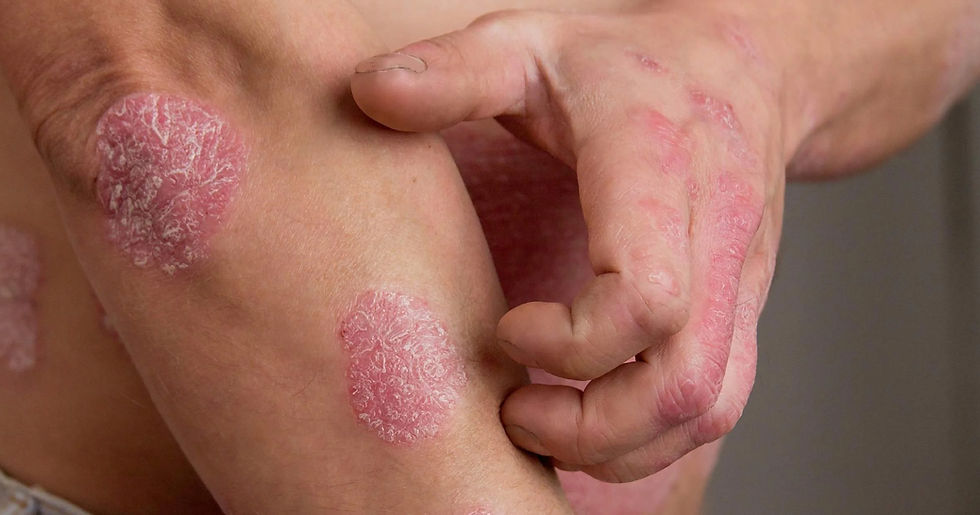
You can have a small flare rather than a full-blown one — a patch that thickens, some scale returning, nothing dramatic. Not a crisis, but not nothing either. And it requires a judgement call rather than a clear "this is a flare, do the flare thing."
And here's the part that catches people out.
Your maintenance line moves
The baseline of your maintenance can shift over the years.
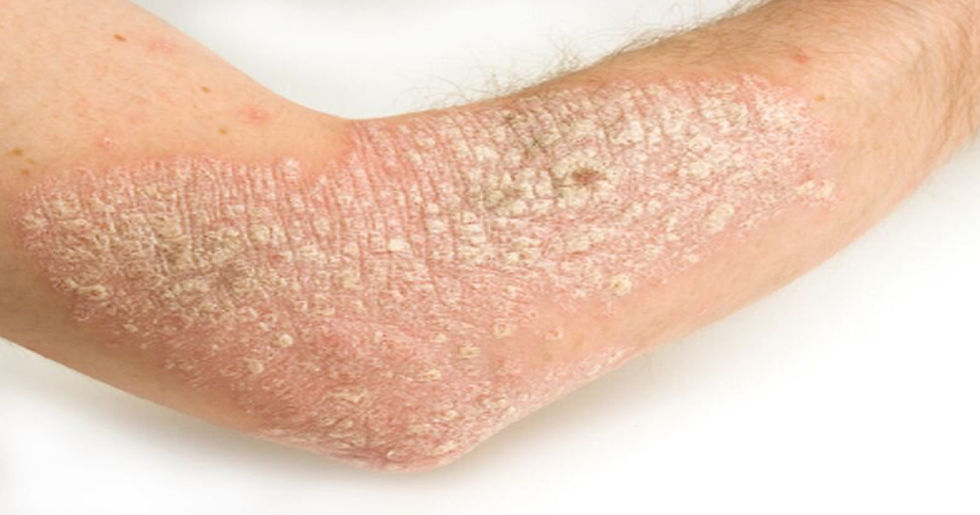
Years ago, well-controlled might have meant your skin was essentially clear. Nearly no mark. You'd look at your elbow and see normal skin.
Now, well-controlled might mean some mild scaling that doesn't itch. Not angry, not spreading, not uncomfortable — just present.
That's your new maintenance line. And the crucial point:
That's not the treatment failing. That's the disease's own trajectory.
I want to state that plainly because of what happens when nobody says it. A patient reaches the same level of control they've always aimed for, sees mild scaling where they used to see clear skin, and concludes something has gone wrong. Then they start looking for what's broken — a new cream, a new doctor, a reason to blame themselves for not being disciplined enough.
None of which is the actual situation. The situation is that the target has moved, and nobody told them.
The new normal, and why naming it helps
Here's what I say to long-term patients, and I say it deliberately.
Your old maintenance skin was smooth. Your current maintenance skin has more scaling but no itch. That is the new normal, and it's still good control.
Naming it does two things.
It stops you chasing a result that isn't currently achievable, which saves you money, time, and the particular exhaustion of feeling you're failing at something.
And it lets you see what's actually happening — because if you're measuring against an outdated target, you can't tell the difference between "my baseline has shifted" and "my psoriasis is genuinely getting away from me." Those need completely different responses, and you can only distinguish them if you know what your current baseline is supposed to look like.
When a shifting baseline does mean something
Now the other side, because I don't want this to read as "accept everything."
A rising maintenance baseline is one of the main things that moves me towards systemic treatment.
The formal trigger for systemic medication is body surface area over about 10% — that's a clear indication. Below that, it's clinical judgement.
And the thing that most often tips that judgement is exactly this pattern: control getting harder year on year. If topical treatment is running to stand still, if what used to hold no longer holds, if the baseline keeps creeping upward — that's information, and it's the kind that argues for changing approach rather than trying harder with the same one.
So the distinction I'm drawing is:
A baseline that has settled at a slightly worse level and is stable — that's the new normal, and we work with it.
A baseline that keeps climbing — that's a signal, and we should be discussing whether topical treatment is still the right tier.
Telling those two apart is why I review psoriasis patients more closely than I review eczema patients. It's not a judgement you can easily make on your own from inside it, and it's not visible in a single snapshot. It needs someone tracking it across visits.
Why this means management is never settled
The practical consequence: psoriasis management has to be adjusted continually. It isn't something you optimise once and then run indefinitely.
What worked at 30 may not be what you need at 45. The regime that held for five years may need revisiting. That's not a failure of the original plan — it's the plan having a natural lifespan.
Which is why I don't discharge psoriasis patients the way I do eczema patients. With eczema I can say: maintain it yourself, message me or come back if you flare. That works because the target is stable.
With psoriasis the target moves, so the relationship has to be ongoing.
What I'm actually doing in all those reviews
Something worth saying plainly, because you may be wondering why I want to see you so often when the medications are straightforward.
I'm not reviewing you because the medication needs supervising. Psoriasis treatment is broadly similar across any doctor who knows what they're doing — the differences are matters of degree, how readily someone goes systemic and how hard they hit it initially.
I'm reviewing you to build your confidence in managing this yourself over time.
Because the factor that actually determines your outcome over decades is not which cream you're on. It's your own consistency in applying it, your ability to recognise a small flare early, your judgement about when something has genuinely changed versus when your baseline has shifted, and your willingness to come back.
Those are skills. They take practice. And they take someone walking through it with you, repeatedly, until you can read your own skin without needing me.
That's what the reviews are for. I'm priming you to run this yourself, over years.
I'd rather say that out loud than have you think I'm just booking appointments.
Expectation is the treatment
If I had to name the single most important thing in long-term psoriasis management — more than any particular medication — it would be expectation.
Not because expectations are a substitute for treatment. But because the long-term stress of this condition is one of its biggest burdens, and a large share of that stress comes from measuring yourself against a target that no longer applies.
The patient who understands that their baseline has shifted, and that this is the disease rather than their failure, carries a lighter load than the patient who thinks they're losing a fight they used to win.
And since stress is one of the commonest triggers I see for psoriasis flares, that isn't just a psychological nicety. Reducing the anxiety about your psoriasis plausibly helps your psoriasis.
If you've had this for twenty years
You may be reading this having been through several doctors, sceptical about what a new one has to offer.
Two honest things.
If those doctors knew what they were doing, they were probably prescribing much what I would. The medications aren't a secret. Chasing a different prescription may not be where your answer is.
What changes outcomes over decades is understanding the disease well enough to adjust as it changes — holding a maintenance line that isn't fixed, recognising a small flare before it becomes a large one, and having expectations that update rather than staying stuck at what your skin looked like in 2005.
That's learnable. That's mostly what I'd be doing with you.
Klinik Dr Tan (Skin & Acne), Lot 27, Ground Floor, Block D, Lintas Square, Kota Kinabalu. WhatsApp 017-234 7328. Appointments preferred.
If you've been managing this alone for years and things have drifted, that's a normal reason to come in — not an admission that you did something wrong.
Book a consultation with Dr. Tan — Book Online or WhatsApp 017-234 7328.
Read more about Psoriasis : Psoriasis Treatment, Psoriasis Is Not Just a Skin Disease, Is It Psoriasis, Eczema, or Fungal, 5 Psoriasis Mistakes
简要说明
我是陈医生,亚庇 Lintas Square 的 Klinik Dr Tan(皮肤与暗疮)。我是对皮肤有专长的普通科医生,不是皮肤专科医生。
这是我最希望二十年前就有人交给我的长期干癣病人的一篇文章,因为它谈的是比任何症状都更让人默默灰心的那件事。
干癣不是「两种状态」的疾病
多数人带着从湿疹借来的心智模型:湿疹相当二分——发作(痒、扩散、发红)或维持(平静、不脱屑),「控制良好」就是处在后者。
干癣不是这样运作的,而且几乎没有人解释过。
干癣有不同程度的发作和不同程度的维持。你可能出现的是小发作而不是全面发作——一块斑变厚、鳞屑回来一些,不戏剧化。不是危机,但也不是没事,而且它需要判断,而不是一句「这是发作,就做发作该做的事」。
你的维持线会移动
几年前,「控制良好」可能代表皮肤基本上干净、几乎没有痕迹。现在,「控制良好」可能代表有些轻微脱屑但不痒——不红肿、不扩散、不难受,就只是在那里。
那就是你新的维持线。而关键是:那不是治疗失败,那是疾病自身的轨迹。
我要把这句话讲清楚,是因为没有人说的时候会发生什么:病人达到了他一向追求的控制程度,却在以前是干净皮肤的地方看到轻微脱屑,于是断定哪里出了问题。然后开始找「坏掉的东西」——新的药膏、新的医生、或者一个责怪自己不够自律的理由。
这些都不是真实的情况。真实的情况是:目标移动了,而没有人告诉他。
说破它有两个作用:让你不再追逐一个目前达不到的结果(省下金钱、时间,以及「觉得自己在失败」的那种特别的疲惫);也让你看清实际发生的事——如果你用一个过时的标准在衡量,你就分不出「我的基线移动了」和「我的干癣真的在失控」。这两件事需要完全不同的应对。
什么时候基线移动是有意义的警讯
维持线持续往上爬,是促使我考虑全身性治疗的主要因素之一。
全身性药物的正式指标是体表面积超过约 10%。低于此则视临床判断——而最常促成判断的,正是这个模式:控制一年比一年难。 外用治疗必须拼命才能原地踏步、以前撑得住的现在撑不住、基线一直往上——那是资讯,而且是「该换层级」而不是「该更努力」的那种资讯。
所以我要区分的是:
基线安定在稍差一点的位置但保持稳定 → 那是新常态,我们据此调整。
基线持续攀升 → 那是讯号,我们该讨论外用治疗是否还是正确的层级。
分辨这两者,正是我复诊干癣病人比湿疹病人更密的原因。 从疾病内部很难自己判断,单一时间点也看不出来,它需要有人跨越多次回诊在追踪。
为什么管理永远不会「settle」:干癣的管理必须持续调整,不是优化一次就能一直跑下去。三十岁有效的,四十五岁未必适用。撑了五年的方案可能需要重新检视——那不是原本计划的失败,那是计划有它自然的寿命。
那些复诊我到底在做什么?
我不是因为药物需要监督才复诊你。 任何懂行的医生开的干癣药大致相似,差别只在程度——多快走向全身性、初期打多重。
我复诊你,是为了建立你长期自我管理的信心。
因为几十年间真正决定你结果的,不是你在用哪一支药膏,而是:你用药的持续性、及早辨认小发作的能力、判断「真的变了」还是「基线移动了」的能力,以及你愿不愿意回来。
那些是技能。需要练习。也需要有人反覆陪你走,直到你不需要我也能读懂自己的皮肤。
期望本身就是治疗
如果要我说长期干癣管理中最重要的一件事——比任何特定药物都重要——那会是期望。
不是说期望可以取代治疗。而是这个疾病的长期压力是它最大的负担之一,而那份压力有很大一部分来自「拿一个不再适用的标准衡量自己」。
明白基线移动了、而且那是疾病而非自己的失败的病人,背负的重量,远轻于那个以为自己正在输掉一场以前赢得了的仗的病人。
而既然压力是我看到最常见的干癣发作诱因之一,这就不只是心理上的体贴——减少你对干癣的焦虑,很可能真的有助于你的干癣。
如果你已经有二十年病史:第一,之前的医生若懂行,开的药大概和我差不多,答案未必在换处方。第二,几十年间真正改变结果的,是够了解这个疾病、能随它改变而调整——守住一条会移动的维持线、在小发作变大之前认出它、并让期望持续更新,而不是停留在你皮肤在 2005 年的样子。那是可以学会的。
Klinik Dr Tan (Skin & Acne),Lot 27, Ground Floor, Block D, Lintas Square, Kota Kinabalu。WhatsApp:017-234 7328。建议预约。
如果你自己撑了很多年、状况慢慢走偏了,那是很正常的回诊理由,不是承认你做错了什么。
Book a consultation with Dr. Tan — Book Online or WhatsApp 017-234 7328.
Comments