


Psoriasis Treatment in Kota Kinabalu

Updated: Sep 29
中文摘要在文末
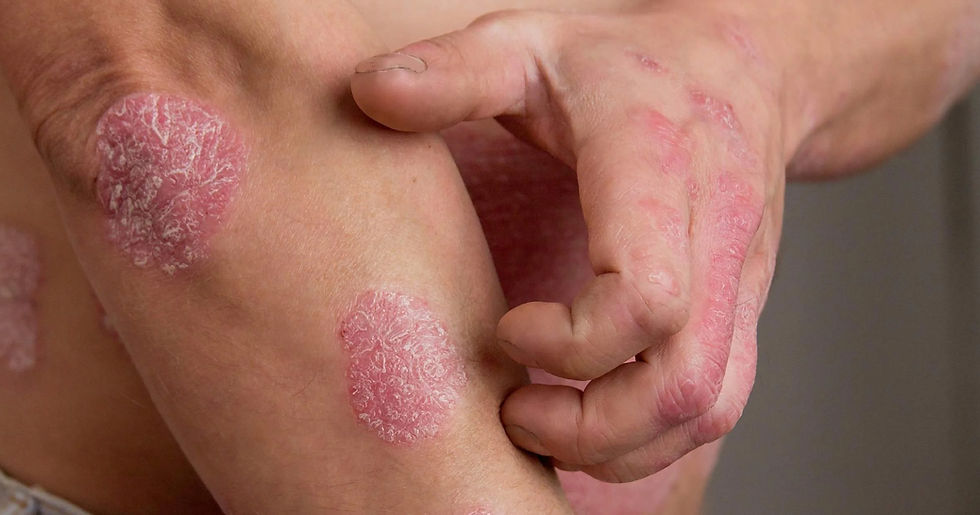
There's something I do in the first consultation with almost every psoriasis patient, and I want to describe it here because it says more than a paragraph of reassurance would.
I examine the affected skin. I touch it — properly, not through a glove held at arm's length. And then I carry on with the consultation. I don't get up. I don't go to the sink. I don't wash my hands as soon as I've finished examining you, in that slightly-too-quick way people do.
Because psoriasis is not contagious, and me demonstrating that is worth more than me saying it.
I know you've probably had the opposite experience. People noticing and moving away. Someone asking if it's catching. The pool, the barber, the swimming lesson, the relative who wouldn't share a towel. Patients tell me about these things years later and the memory is still sharp.
So that's where I start. It isn't contagious, and I'll show you rather than tell you.
What psoriasis actually is
The second thing I tell patients is that this is not just a skin condition. It's systemic.
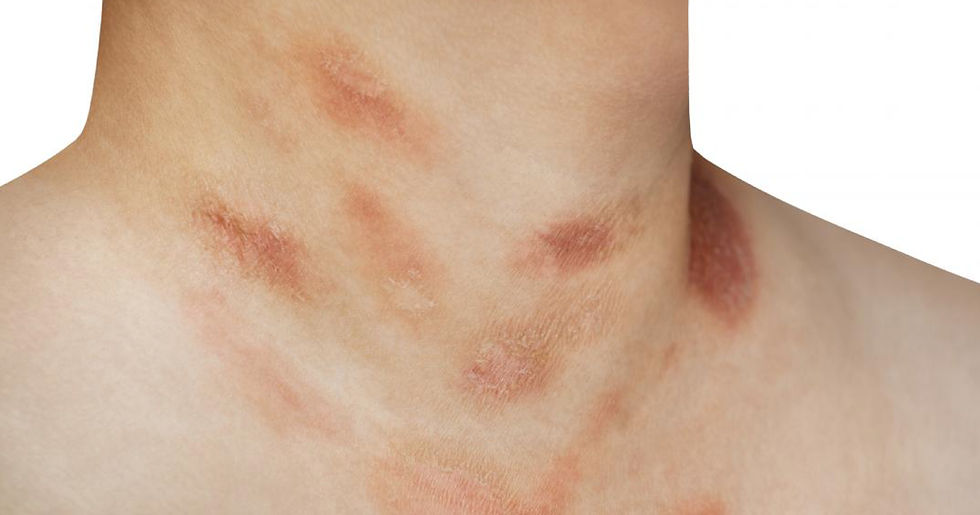
Psoriasis is an immune-mediated disease. Your immune system is driving inflammation, and skin is where you can see it — but it's not the only place it's happening. That's why psoriasis can affect joints, and why it sits alongside other health considerations we'll come to.
And then the honest part, which I'd rather say in the first ten minutes than have you work out over two years:
We can usually control psoriasis. We usually cannot cure it.
That's the sentence. It's not what anyone wants to hear, and I don't dress it up. But controlled psoriasis and uncontrolled psoriasis are two enormously different lives, and the work is worth doing.
How it differs from eczema, and why that matters for treatment
I treat a lot of eczema, and the two behave differently in ways that change how I approach them.
Eczema is fairly binary. There's a flare — itchy, spreading, angry. And there's maintenance — calm, no scale. You go between the two states.
Psoriasis is not binary, and this is the thing most patients aren't told.
Psoriasis has degrees of flare and degrees of maintenance, and both can shift over time. You can have a small flare rather than a full-blown one. And — this is the important bit — the baseline of your maintenance can change over the years.
What that looks like in practice: years ago, well-controlled meant your skin was essentially clear, almost no mark. Now, well-controlled means some mild scaling that doesn't itch. That's your new maintenance line.
That's not treatment failing. That's the disease's own trajectory, and it means management has to be adjusted continually rather than settled once.
I'd rather you knew that early, because the patient who expects the same result they got a decade ago will conclude everything has stopped working — when actually what's needed is a recalibration. There's a whole article on this, because I think it's the single most useful thing to understand about living with psoriasis long-term.
How I treat it
I go aggressive first. More often than not, going gently isn't enough — and psoriasis also takes longer to respond than eczema does, so a cautious approach means waiting a long time to find out it wasn't sufficient.
So: potent topical treatment to get control. Typically around two weeks to bring it under control, though it varies.
Then I step down — to a combination of a steroid and a vitamin D analogue.
Then step down again — to the vitamin D analogue alone.
Alongside all of that, from early on and continuing throughout: coal tar as the basic maintenance. It isn't glamorous and it has a smell people have opinions about, but it's a genuinely useful long-term agent and I start it early rather than treating it as a last resort.
Salicylic acid where thick scale is the problem, to break it down so the other treatments can reach the skin underneath.
And one difference from my eczema patients worth mentioning: for psoriasis I use urea-based cream as the main emollient, rather than the ceramide-based ones I reach for in eczema and most other dermatitis. Different problem, different requirement.
When creams aren't enough
Two triggers move me to systemic treatment.
If more than about 10% of your body surface is involved, that's a clear indication — no real judgement call required.
Below that, it's clinical judgement — and the thing that most often tips it is the pattern I described above: the maintenance baseline creeping upwards over time. If controlling it is getting harder year on year, and topical treatment is running to stay still, that's a signal.
When I start systemic treatment, I generally use apremilast, because it's better tolerated with fewer side effects than some alternatives, which matters a great deal in a lifelong condition where you may be on something for years.
If you need a higher tier of treatment than that, I refer you to a hospital dermatologist. That includes phototherapy, which is one of the main reasons I refer, and the more advanced systemic options.
I'm a GP with a strong interest in skin, not a dermatologist. Knowing where my limit is and referring at that point is part of doing this job properly, not an admission of defeat.
About your joints — please read this bit
This is the most important paragraph in this article.
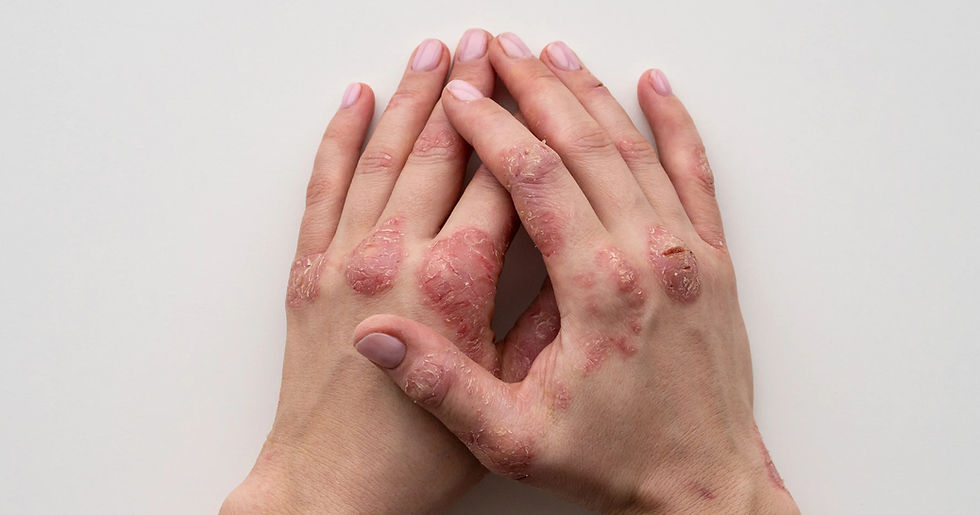
Psoriasis can affect joints. Psoriatic arthritis is a real part of this disease, not a coincidence, and joint damage, once it happens, does not reverse. That's what makes it different from the skin side, where we can always try again.
So I ask about joints. Stiffness, particularly in the morning. Pain or swelling in fingers, toes, back. Whether anything has changed in how you use your hands.
And I want to be straightforward with you about my own position here: I'm a skin doctor. I'm not a joint doctor, and I'm not an all-rounder. My ability to diagnose psoriatic arthritis well is limited, and I know it.
So I keep a low threshold for referring to rheumatology. If there's a question about your joints, I'd rather send you to someone who assesses joints all day than have a go myself and be wrong about something irreversible.
I think recognising your own incompetence and getting help is one of the more important skills in medicine. It's certainly more useful than pride.
What I need from you: mention joint symptoms even if you're sure they're unrelated. Especially then. Patients routinely don't mention stiff fingers because they've filed it under "getting older" or "I've been working hard." That's exactly the information I need, and by the time it's obvious, damage may already have happened.
The part nobody sees
Psoriasis carries a mental burden that I don't think gets enough attention.
It's lifelong. It's visible. It's on display in a culture where people comment. It flares when you're stressed, which means it flares at exactly the times you have least capacity to deal with it. And patients carry a background level of stress about it more or less permanently.
I take that seriously in how I manage people, in a specific and practical way.
There are things that likely help psoriasis — alcohol, smoking and weight all come up in the research as factors that, better controlled, may improve how well psoriasis is controlled. I'll mention them as a list if you ask what else you can do beyond medication, and I'll go into detail if you want it.
But I don't push them on someone who's already carrying as much as they can carry.
I run a weight management programme at this clinic. If you have psoriasis and you're overweight, I could probably make a case for it. And I generally won't raise it, unless you do — because psoriasis is already taxing, and stacking another demanding long-term programme on top of someone who's stressed and struggling risks a breakdown rather than an improvement.
If you ask me about it, we'll talk properly. If you don't, I'll assume you've got enough on.
Same with sunlight, incidentally. In theory it helps psoriasis. In practice I don't see much benefit here, and I think I know why — psoriasis patients often have low self-esteem about how their skin looks, avoid going out, and cover up completely when they do. Telling someone to go and expose their skin to the sun, when their whole instinct is to hide it, is not a small ask. So I don't press it.
What I'd do differently from another doctor
Honestly? Not much on the medications.
Psoriasis treatment is broadly similar across any doctor who knows what they're doing. The differences are matters of degree — how readily someone moves to systemic treatment, how hard they hit it initially. That's it.
The factor that actually determines your outcome is your own consistency — applying treatment properly, and coming back.
So what I do differently is review you more tightly. Not because the medications need supervision, but because I'm trying to build your confidence in managing this yourself over time.
With eczema I can say: maintain it on your own, message me or come back if you flare. Psoriasis doesn't work that way. There's a maintenance line you have to actively hold, and there are partial flares that need judgement calls rather than a clear "this is a flare, do the flare thing." That takes practice, and it takes someone walking through it with you until you can read your own skin.
That's what the reviews are for. I'm priming you to run this yourself, over years.
If you've had this for twenty years
Some of you have been through several doctors and are reading this sceptically.
I'd say two things. First, if the previous doctors knew what they were doing, they were probably prescribing much what I would. Chasing a different prescription may not be where your answer is.
Second, the thing that changes outcomes over decades isn't finding the right cream. It's understanding the disease well enough to adjust as it changes, holding a maintenance line that isn't fixed, and having realistic expectations that update over time.
That's learnable. That's mostly what I'd be doing with you.
Coming in
Klinik Dr Tan (Skin & Acne), Lot 27, Ground Floor, Block D, Lintas Square, Kota Kinabalu. WhatsApp 017-234 7328. Appointments preferred — first psoriasis consultations need proper time.
Bring everything you've used and any records of what you've been on. And if family come with you, that's genuinely useful. I'll explain the not-contagious part to them directly, because convincing the people around you is often harder than convincing you, and it's not a job you should have to do alone.
Book a consultation with Dr. Tan — Book Online or WhatsApp 017-234 7328.
Read more about Psoriasis : Psoriasis Treatment, Psoriasis Is Not Just a Skin Disease, Scalp and Nail Psoriasis, The Moving Baseline, 5 Psoriasis Mistakes
简要说明
我是陈医生,亚庇 Lintas Square 的 Klinik Dr Tan(皮肤与暗疮)。我是对皮肤有专长的普通科医生,不是皮肤专科医生。
我在几乎每一位干癣(银屑病)病人的初诊都会做一件事:我检查患部、确实地触摸它,然后继续问诊——我不会站起来去洗手,不会用那种稍微太快的方式去洗手。
因为干癣不会传染,而我用行动示范,比我用嘴巴说更有力。
我知道你可能有过相反的经验:有人注意到之后退开、有人问会不会传染、游泳池、理发店、不愿共用毛巾的亲戚。病人多年后跟我说起这些事,记忆仍然清晰。
第二件我会告诉病人的事:这不只是皮肤病,它是全身性的。 干癣是免疫介导的疾病——免疫系统在驱动发炎,皮肤只是你看得见的地方,不是唯一发生的地方。所以它会影响关节。
然后是诚实的部分:干癣通常可以控制,但通常无法根治。 这不是任何人想听的话,但受控的干癣和失控的干癣,是两种差异极大的人生。
和湿疹的差别(这一点很重要):湿疹相当二分——发作(痒、扩散)或维持(平静、不脱屑)。干癣不是二分的。 它有不同程度的发作和不同程度的维持,而且两者都会随时间改变。
实际的样子是:几年前「控制良好」代表皮肤几乎完全干净;现在「控制良好」代表有些轻微脱屑但不痒。那就是你新的维持线。
那不是治疗失败,那是疾病自身的轨迹,意味着管理必须持续调整,而不是一次settle。另有专文详述。
我的治疗方式:
先用强效。走温和路线往往不够,而干癣的反应本来就比湿疹慢,保守的做法等于花很长时间才发现它不够。约两周取得控制。
然后降阶——类固醇加维生素D衍生物的复方。
再降阶——单用维生素D衍生物。
煤焦油(coal tar)从早期就开始,并全程维持,作为基本的维持治疗。
水杨酸用于厚鳞屑,把鳞屑软化让其他药物能到达底下的皮肤。
保湿以尿素(urea)为主,而非我在湿疹使用的神经酰胺类。
什么时候需要全身性治疗:体表面积超过约 10% 是明确指标。低于此则视临床判断——最常促成决定的,是维持线逐年往上爬。我通常使用 apremilast,因为耐受性较好、副作用较少,这在可能需要长期用药的终身疾病中很重要。需要更高阶的治疗,我会转介医院皮肤专科,包括光疗。
关于你的关节——请务必读这段
干癣可以影响关节。乾癣性关节炎是这个疾病的一部分,不是巧合,而且关节一旦受损就无法逆转。这跟皮肤不同,皮肤我们随时可以再试。
所以我会问关节:晨间僵硬、手指脚趾或背部的疼痛或肿胀、使用双手的方式有没有改变。
我要坦白我的位置:我是皮肤科医生,不是关节医生,也不是全科通才。 我诊断乾癣性关节炎的能力有限,而我知道这一点。所以我对转介风湿科的门槛很低——与其自己冒险判断一件不可逆的事情,不如把你交给每天在看关节的人。
认清自己的不足并寻求协助,是医学里更重要的能力之一,肯定比自尊有用。
我需要你做的:即使你确定关节症状无关,也请说出来。尤其是那种时候。 病人常常不提手指僵硬,因为已经归类为「年纪大了」或「最近做工太累」。那正是我需要的资讯——等到明显时,损伤可能已经发生。
没有人看见的那一面:干癣的心理负担被严重低估。它是终身的、看得见的、会因压力而发作——而那正是你最没有余裕应付的时候。
我在管理上认真看待这件事,而且做法很具体:研究提到酒精、吸烟、体重若控制得好,可能改善干癣的控制。如果你问我除了药物还能做什么,我会把这些当成一份清单说给你听,你想深入我就细谈。
但我不会把这些压在一个已经承受到极限的人身上。
我的诊所有体重管理计划。如果你有干癣又过重,我大概可以说出一套理由。但除非你主动问,我通常不会提——因为干癣本身已经很消耗,在一个压力已经很大的人身上再叠加一个要求很高的长期计划,风险是崩溃而不是改善。
你问,我们就好好谈。你不问,我就当你已经够忙了。
晒太阳也一样。理论上对干癣有帮助,但我在本地看不到太多这种效果,我想我知道原因——干癣病人往往对自己的皮肤缺乏自信,不太出门,出门也包得密不透风。叫一个本能上想遮住皮肤的人去晒太阳,不是一个小要求。所以我不会硬推。
我和别的医生有什么不同? 老实说,用药上没有太多不同。任何懂行的医生开的药大致相似,差别只在于多快走向全身性治疗、初期打多重。
真正决定你结果的,是你自己的持续性——正确用药,以及回诊。
所以我做的不同的事是:我复诊得更密。不是因为药物需要监督,而是因为我在建立你长期自我管理的信心。湿疹我可以说「自己维持,发作了再来」。干癣不行——有一条需要主动守住的维持线,还有需要判断的「小发作」。那需要练习,也需要有人陪你走到你能读懂自己的皮肤为止。
如果你已经有二十年病史:第一,之前的医生若懂行,开的药大概和我差不多,答案未必在换处方。第二,几十年间真正改变结果的,是够了解这个疾病、能随它改变而调整、守住一条会移动的维持线,并且让期望随时间更新。那是可以学会的。
Klinik Dr Tan (Skin & Acne),Lot 27, Ground Floor, Block D, Lintas Square, Kota Kinabalu。WhatsApp:017-234 7328。建议预约。
请把用过的药都带来。如果家人愿意一起来,那非常有帮助——我会直接向他们说明不会传染这件事,因为说服身边的人往往比说服你更难,而那不该由你独自承担。
Book a consultation with Dr. Tan — Book Online or WhatsApp 017-234 7328.

Comments