


Scalp and Nail Psoriasis: The Two Hardest Places

Updated: Sep 29
中文摘要在文末
Scalp is the second most common site I see psoriasis, after plaques on the body. Nails come a little further down the list, alongside palmoplantar and inverse psoriasis.
Both are disproportionately difficult, and for completely different reasons. Scalp is hard because getting treatment onto the skin through hair is a genuine practical problem. Nails are hard because they take a long time and because they're frequently mistaken for something else entirely.
Scalp psoriasis
It isn't dandruff, and being told it is wastes years
The commonest thing that happens with scalp psoriasis is that it gets treated as dandruff — by the patient, sometimes by other people — for a long time before anyone looks properly.
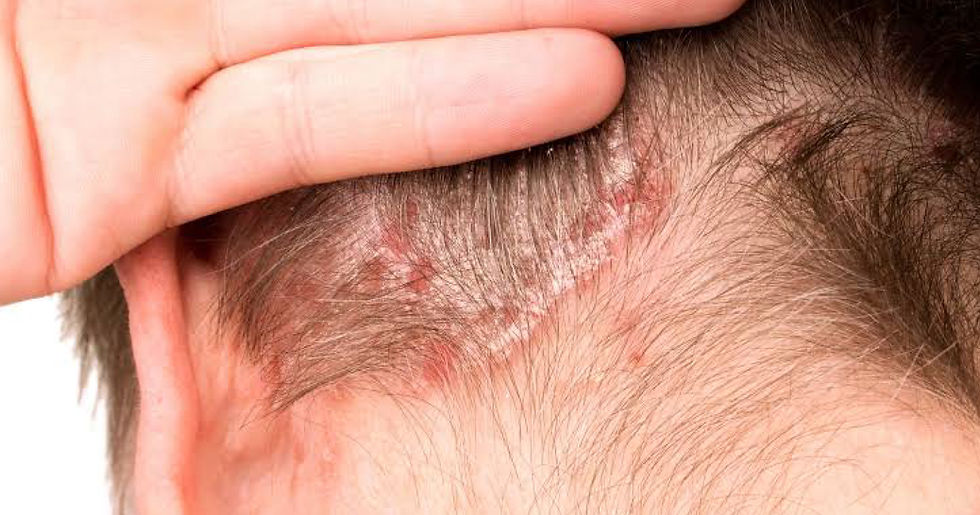
The differences are usually visible once you know what you're looking at. Scalp psoriasis tends to produce thicker, more adherent scale than dandruff, often in defined patches rather than diffusely, and it commonly extends past the hairline— onto the forehead, behind the ears, at the back of the neck. That extension beyond the hair-bearing scalp is a useful clue.
It can also be genuinely miserable in a way dandruff usually isn't. Itchy, visible on dark clothing, and the scale builds up in a way that's hard to conceal.
The actual problem is delivery
Here's what makes scalp psoriasis frustrating to treat, and it isn't the disease.
Treatment has to reach the skin, and there's hair in the way.
That's it. The medications work perfectly well. But a cream that would be straightforward on an elbow becomes a real exercise on a scalp — hard to apply to the right place, hard to know whether it's reached the skin or just coated the hair, and unpleasant enough that people quietly stop.
So the choice of preparation matters more here than almost anywhere else in dermatology, and it's driven by how much scalp is involved.
What I use
If it's localised — a few defined patches — I use a potent steroid scalp application. These are formulated to get through hair to the skin, which ordinary creams aren't. You part the hair and apply to the patch itself.
If it's widespread — most of the scalp involved — a scalp application becomes impractical, so I use a potent steroid shampoo for the whole scalp instead.
Either way, use it regularly until it's under control. Not intermittently, not when it looks bad. Consistently, until the scalp is genuinely settled.
Then we taper — stepping down slowly onto tar shampoo for maintenance.
That tapering is the part people skip, and it's why scalp psoriasis has a reputation for bouncing straight back. Getting it clear and then stopping abruptly is not a plan.
Making it actually happen
Some practical points, because compliance is the whole game here.
Part the hair properly when applying a scalp application. Systematically, section by section. It takes a few minutes and it's the difference between treating your scalp and treating your hair.
Leave shampoos on the scalp before rinsing. A medicated shampoo rinsed straight off does very little — it needs contact time on the skin. Apply it, do everything else in the shower, rinse it last.
Tar shampoo has a smell. People have opinions about it. It's also genuinely useful for long-term maintenance, so my suggestion is to use it in the evening rather than before work, and to judge it on how your scalp is doing in six months rather than on the first application.
Don't pick the scale off. This is very tempting, particularly when it's thick and lifting at the edges. But psoriasis responds badly to skin trauma, and picking can worsen or extend a patch. If thick scale is the problem, tell me — there are treatments to soften it, including salicylic acid preparations, and that's a better route than your fingernails.
If it's affecting your sleep or your mood, say so. Scalp involvement is visible and itchy and it wears people down. That's relevant clinical information, not a complaint.
Nail psoriasis
Telling it from nail fungus
These two look similar enough that they're regularly confused, they can occur in the same person at the same time, and their treatments have nothing in common. So it's worth getting right.
Nail psoriasis changes the structure of the nail. The nail becomes thicker, and you often see pitting — small depressions in the nail surface, as though it had been pressed with a fine point. Pitting in particular is characteristic.
Nail fungus is more about deposition and discolouration. The change comes from fungal material accumulating under and within the nail, which typically appears as a powdery deposit and a colour change. In some cases you get separation of the nail from the nail bed underneath.
If I'm not sure, we can take a sample and do KOH microscopy, looking directly for fungal elements. That's a straightforward way to settle it, and it also answers the question of whether both are present — which does happen, and which matters, because treating only one will leave you frustrated.
Why this distinction matters so much
Because the treatments are entirely different, and getting it wrong wastes months.
Treating psoriatic nails with antifungal tablets exposes someone to a medication with real considerations, including liver monitoring on longer courses, for no benefit at all.
Treating fungal nails as psoriasis leaves an infection running.
And nails are slow either way — you're judging progress over months, so a wrong turn costs a great deal of time before it becomes obvious.
What to expect from nail treatment
I'll be straightforward: nail psoriasis is one of the more stubborn manifestations, and it responds more slowly than skin.
Part of that is the same constraint as nail fungus — you're waiting for the nail to grow out. The damage that's already in the nail plate doesn't repair. Treatment works on what forms next, and then the nail has to grow forward carrying the old damage to the tip. Fingernails are faster than toenails, considerably.
So judge progress at the base of the nail, near the cuticle. New growth appearing normal there is the sign that treatment is working, even while the rest of the nail still looks poor.
If nail involvement is extensive or particularly troublesome, that can contribute to a decision to move to systemic treatment — nails are one of the sites where topical treatment struggles most.
One more reason to mention your nails
There's a connection worth knowing about: nail involvement is associated with psoriatic arthritis.
So if your nails are affected, I'll ask about your joints more carefully — stiffness, particularly in the morning, and pain or swelling in fingers, toes or back.
Please answer that question fully even if you're sure the two are unrelated. Joint damage doesn't reverse, which makes it the one part of this disease where a delay costs something permanent. There's a separate article on this and it's the one I'd most want you to read.
When these sites change the overall plan
Both scalp and nails can influence whether I move to systemic treatment, even when the total body surface area involved is modest.
The formal trigger for systemic treatment is more than about 10% of body surface area. Below that it's clinical judgement — and part of that judgement is impact rather than area. Scalp psoriasis that's visible, itchy and affecting your sleep, or nail psoriasis that's affecting how you use your hands or how you feel about being seen, matters more than the percentage suggests.
So tell me how it's actually affecting you. That's not an aside to the medical assessment; it's part of it.
Klinik Dr Tan (Skin & Acne), Lot 27, Ground Floor, Block D, Lintas Square, Kota Kinabalu. WhatsApp 017-234 7328. Appointments preferred.
I'm a GP with a strong interest in skin, not a dermatologist. Where a case needs specialist assessment or phototherapy, I refer to hospital dermatology.
Book a consultation with Dr. Tan — Book Online or WhatsApp 017-234 7328.
Read more about Psoriasis : Psoriasis Treatment, Psoriasis Is Not Just a Skin Disease, Is It Psoriasis, Eczema, or Fungal, The Moving Baseline, 5 Psoriasis Mistakes
简要说明
我是陈医生,亚庇 Lintas Square 的 Klinik Dr Tan(皮肤与暗疮)。我是对皮肤有专长的普通科医生,不是皮肤专科医生。
头皮是我看到干癣第二常见的部位(仅次于身体斑块),指甲则再往后一些,与掌跖型和反向型相近。两者都特别难处理,但原因完全不同。
头皮干癣
它不是头皮屑,而被当成头皮屑处理会浪费好几年。差别通常看得出来:干癣的鳞屑更厚、更黏附,常呈界线分明的斑块而非弥漫性,而且经常越过发际线——到额头、耳后、后颈。超出长发部位的延伸是很有用的线索。
真正的难题是「送达」——药必须到达皮肤,而中间有头发挡着。药本身没问题,但在手肘上很简单的乳膏,到了头皮就变成一件苦差事:不容易涂到正确的位置、不确定有没有真的到达皮肤、而且用起来不舒服到让人默默放弃。
我的用药:
局限性的(几块界线分明的斑块):强效类固醇头皮用制剂(scalp application)。这类剂型是为了穿过头发到达皮肤而设计的,一般乳膏做不到。拨开头发,涂在斑块上。
范围广的(大部分头皮):头皮用制剂变得不切实际,改用强效类固醇洗发剂洗全头皮。
无论哪一种,规律使用直到控制住——不是断断续续,不是看起来糟才用。
然后逐步递减,慢慢转到煤焦油洗发剂做维持。
递减这一步是大家最常略过的,也是头皮干癣以「一停就复发」出名的原因。弄干净然后突然停掉,不是一个计划。
实务重点:确实拨开头发、一区一区涂(这是「治头皮」和「治头发」的差别);洗发剂要在头皮上停留一段时间再冲(一进浴室先抹上,做完其他事最后才冲);煤焦油洗发剂有味道(建议晚上用,并以半年后的头皮状况来评价它);不要把鳞屑抠掉(干癣对皮肤创伤反应很差,抠会让斑块恶化或扩大;鳞屑太厚请告诉我,有水杨酸之类的软化方式);影响睡眠或情绪请说出来,那是临床资讯,不是抱怨。
指甲干癣
和灰指甲怎么分(两者外观相似、可以同时存在、治疗却完全不同):
指甲干癣改变指甲的结构——指甲变厚,常见凹点(pitting),像被细尖压过的小凹陷。凹点特别有特征性。
灰指甲主要是沉积和变色——真菌物质堆积在指甲下方和内部,典型是粉状沉积加上颜色改变,有些会出现甲床与指甲分离。
不确定时可以取样做 KOH 显微镜直接找真菌。这也能回答「是不是两者都有」——这确实会发生,而且很重要,因为只治一种会让你很挫折。
为什么这个区分这么重要:治疗完全不同,弄错会浪费好几个月。把干癣的指甲当灰指甲治,等于让人服用需要肝功能监测的药物却毫无益处;把灰指甲当干癣治,则是放着感染不管。而且指甲无论如何都很慢——进展以月计算,走错方向要很久才会明显。
治疗期望:指甲干癣是比较顽固的表现之一,反应比皮肤慢。部分原因跟灰指甲一样——你在等指甲长出来。已经在甲板里的损伤不会修复,治疗作用在接下来长出来的部分,然后指甲必须往前长、把旧的损伤带到尖端。手指甲比脚趾甲快得多。
所以看进展要看指甲根部(靠近甲缘)。那里长出正常的新甲,就代表治疗有效,即使其余部分看起来还是很糟。
多提一个理由要说你的指甲:指甲侵犯与乾癣性关节炎有关联。 所以如果你的指甲受影响,我会更仔细询问关节——晨间僵硬,以及手指、脚趾、背部的疼痛或肿胀。即使你确定两者无关,也请完整回答。关节损伤不可逆,这是这个疾病里唯一「延误会造成永久代价」的部分。另有专文,那是我最希望你读的一篇。
这两个部位会改变整体计划
全身性治疗的正式指标是体表面积超过约 10%。 低于此则视临床判断——而判断的一部分是「影响」而不是「面积」。 看得见、会痒、影响睡眠的头皮干癣,或影响你使用双手、影响你面对他人的指甲干癣,其重要性高于百分比所显示的。
所以请告诉我它实际上如何影响你。那不是医疗评估之外的闲聊,那是评估的一部分。
Klinik Dr Tan (Skin & Acne),Lot 27, Ground Floor, Block D, Lintas Square, Kota Kinabalu。
WhatsApp:017-234 7328。建议预约。需要专科评估或光疗时,我会转介医院皮肤科。
Book a consultation with Dr. Tan — Book Online or WhatsApp 017-234 7328.

Comments